


Wholly owned and operated by Nurses Specialized in Wound, Ostomy and Continence Canada (NSWOCC)




Nurse Continence Advisor (NCA) Course
Are you a Registered Nurse seeking advanced knowledge & clinical expertise in continence care?
The Canadian Nurse Continence Advisor (NCA) Course is a rigorous, paced, 12-month course that prepares baccalaureate-prepared registered nurses for the specialized role of a Nurse Continence Advisor (NCA).
Grounded in nationally recognized nursing standards and competencies, the program equips graduates to deliver safe, ethical, and evidence-informed continence care. It supports the acquisition, integration, and practical application of knowledge, enabling learners to confidently translate theory into clinical practice.

The Canadian Nurse Continence Advisor (NCA) Course is accredited by the Canadian Nurses Association (CNA) for 160 educational credits and is the only Canadian advanced continence management course to hold this accreditation.
CNA accreditation is a key indicator to patients, employers, the public, and professional licensing bodies that NCA graduates have completed a rigorous, evidence-informed program that meets nationally recognized standards for nursing education and practice.

Course Goals and Objectives
The Nurse Continence Advisor Course reflects the standards and best practice principles of Nurses Specialized in Wound, Ostomy, and Continence Canada (NSWOCC) relevant to continence-focused nursing roles.
The course emphasizes:
-
Comprehensive and focused continence assessments
-
Evidence-informed, conservative management strategies
-
Preservation of skin integrity
-
Appropriate continence product selection
-
Patient, client, and caregiver education
-
Interprofessional collaboration
These principles align with NSWOCC’s expectations for advanced clinical knowledge, leadership, consultation, and education within continence practice.
The Nurse Continence Advisor Course prepares registered nurses with the specialized knowledge, clinical reasoning, and applied skills required to deliver comprehensive, evidence-informed continence care across diverse practice settings. The course promotes person-centred, dignity-preserving, and prevention-focused approaches to bladder and bowel health, while supporting nurses to function as clinical resources, educators, and advocates within interprofessional teams.
NCA Course Overview:
Theoretical & Clinical Components
The Canadian Nurses Association (CNA)–accredited Nurse Continence Advisor (NCA) Course consists of a six-month paced online theoretical component, followed by 75 hours of structured clinical preceptorship and additional self-directed clinical learning.
The theoretical component of the course focuses on:
-
Normal and altered bladder and bowel function
-
Continence assessment frameworks
-
Types of urinary and fecal incontinence
-
Contributing risk factors
-
Conservative management strategies
-
Product selection
-
Skin protection
-
Documentation
-
Quality-of-life considerations
The clinical preceptorship is a required, practice-based component of the Nurse Continence Advisor Course. It is designed to consolidate and apply theoretical knowledge within a supervised clinical environment.
Students may begin their clinical placement after successfully completing the theoretical component of the program. The clinical placement includes 75 hours (10 days) of direct clinical practice with a preceptor, as well as the completion of 20 case studies drawn from the student’s own work environment. Students will have six (6) months to complete the clinical portion of the course.
The preceptorship must be completed under the supervision of a qualified health professional with advanced expertise in continence care.
Approved preceptors may include, but are not limited to:
-
Nurse Continence Advisors
-
Nurses Specialized in Wound, Ostomy, and Continence (NSWOCs) with advanced practice in continence care
-
Urologists
-
Pelvic floor physiotherapists
-
Other approved clinicians with demonstrated expertise in continence care
The NCA Advantage
Employing a Nurse Continence Advisor (NCA) is an effective strategy for improving outcomes for individuals living with urinary and fecal continence concerns through high-quality, evidence-informed care.
NCAs serve as sources of specialized expertise for interdisciplinary health care teams and contribute to best practice and protocol development, research, education, and advocacy. NCA graduates are equipped to lead continence-focused teams and possess the knowledge, skills, and clinical judgment required to manage complex patient needs related to continence care.
The NCA Course is a rigorous, competency- and standards-of-practice–guided program designed to ensure the high quality of its graduates. Through a CanMEDS-styled, competency-based clinical preceptorship, the program supports mentorship and the development of future nurse leaders.
Graduates of the Canadian NCA Course demonstrate advanced levels of critical thinking, clinical expertise, and leadership, reflecting excellence in continence care practice.
Course Learning Outcomes
The course is designed to support learners in developing the competencies required for effective Nurse Continence Advisor (NCA) practice, including the ability to:
-
New knowledge, skills and attitudes and integrate them with prior knowledge, skills and attitudes to prepare the learner to become a competent NCA;
-
Familiarity with the literature in the field of
-
Specialized Continence Nursing;
-
The skills to critically analyze practice in the field, differentiate it from best practice and disseminate standards of NCA practice; and
-
Problem solving skills through case-based learning and participation in a strong learning community.
Learners will attain the knowledge required to:
-
Articulate and uphold the professional responsibilities of the Nurse Continence Advisor role
-
Recognize and respond to the psychosocial needs of individuals experiencing continence-related concerns
-
Plan and manage continence care across the lifespan using an evidence-informed approach, including:
-
-
Conducting comprehensive continence assessments
-
Applying conservative management strategies (including theory on pessary insertion and management)
-
Supporting and preserving skin integrity
-
Selecting appropriate continence products based on individual needs
-
Providing patient and caregiver education
-
Collaborating effectively within interprofessional teams
-
Is the NCA Course right for you?
Learn on an interactive online platform, building strong relationships with colleagues and specialists from across Canada online and in clinical settings.
Care to be the best by graduating from the most rigorous academic and clinical continence education course available in Canada (75 hours of supervised clinical placement and 75 hours of independent practice in your own work setting). Lead continence management in any Canadian Healthcare setting including acute care, rehabilitation, community care and long-term care.

Eligible Applicants
Eligible applicants must be Baccalaureate prepared Registered Nurses with at least 2 years of full-time employment in the last 3 years as a Registered Nurse, in a clinically relevant area of practice. Conisderation will be given to nurses working in an NCA related role or a urology nursing role.
Applications are received twice per year, with the course starting in September and March. For more information about eligibility and applications, please visit www.wocinstitute.ca.
Recognition of Prior Learning
Graduates from the NCA Course who wish to bridge to the NSWOC Program will receive full credit for the continence management program. NCA’s will be required to complete the ostomy and wound management programs and complete the CNA WOCC(C) certification exam to receive the WOCC(C) credential.
Application Process
The current application deadline for class 2 is September 1st, 2026. The start date for class 2 is September 14th, 2026. This course currently runs one time per year, with an annual start date of mid-September. If you have any questions concerning the application process, please feel free to reach out at:
Toll Free: 1-877-614-1262

Step 1 - Option B
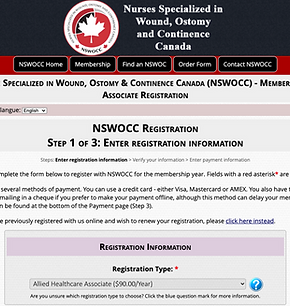
Register as an Allied Healthcare Professional Associate
If you are not an NSWOCC Member, you may apply by registering as an Allied Healthcare Professional Associate. After completing this registration, you will have access to “Register Now.”
The personal information collected during application and maintained as part of a student’s records will be used for the purposes of admission, registration, and issuing receipts, graduation certificates, and for research and planning. Contact information will also be disclosed to NSWOCC for the purpose of providing membership information. Personal information will not be shared with any other business or organization.


Step 5
Complete the course prerequisites
Once you return to your membership account, click on "Review my course registrations", in the left-hand sidebar then complete the pre-requisites by clicking each item in the checklist.
For those items that require copies of scanned documents, you can upload them within the main Members area page by clicking "Upload Documents to NSWOCC" and following the instructions.

After application is complete
Application will be reviewed by the admissions committee after the application deadline date.
Once all your prerequisites have been submitted, your application will be submitted to our admissions committee.
All completed applications will only be reviewed after the application deadline regardless of when your application is completed.
Offers of admission will be emailed after the application deadline date.

NCA Program Info Night Recording
Costs & Tuition:
$3000
Course Tuition Fee
Not including Textbook and any additional Preceptorship costs.